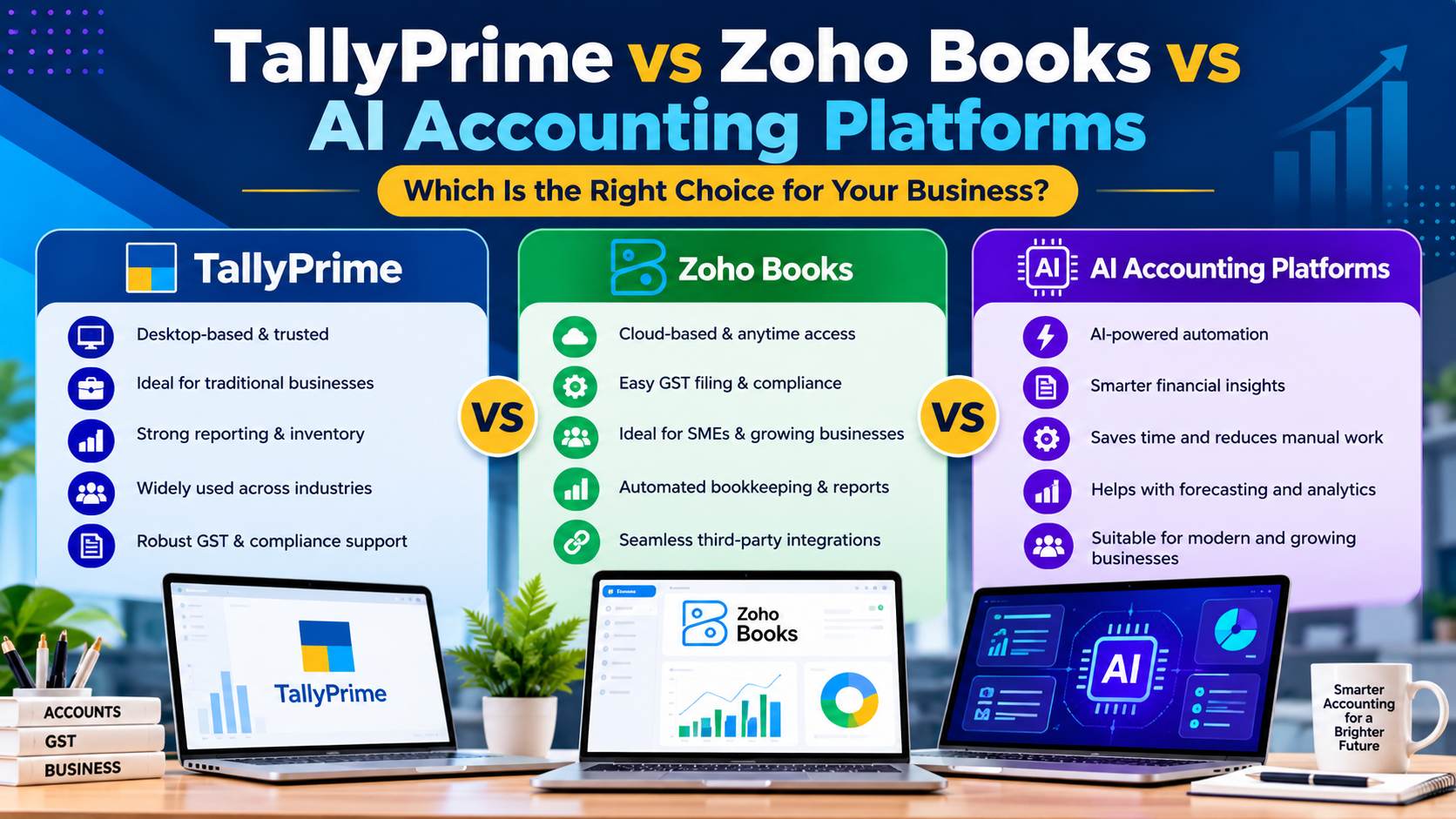
TL;DR: Quick Summary
Choosing the best accounting software for CA firms in India depends on client requirements, GST workflows, automation needs, and budget. Traditional solutions offer established accounting capabilities, while cloud and AI-powered platforms can improve collaboration and reduce repetitive tasks.
Choosing the right accounting software is becoming increasingly important for Chartered Accountant (CA) firms in India. Beyond maintaining ledgers and financial statements, firms must manage GST compliance, reconcile transactions, collaborate with clients, and deliver accurate reports without allowing routine accounting work to consume excessive time.
Traditional platforms such as TallyPrime and BUSY continue to offer established accounting capabilities, while cloud solutions like Zoho Books and emerging AI-powered tools are introducing new approaches to automation. This guide compares seven of the best accounting solutions for Indian CA firms in 2026, examining features, GST workflows, AI capabilities, pricing, collaboration, and scalability to help firms select the right combination of tools.
Key Highlights:
- TallyPrime: Best for traditional accounting, GST compliance, and detailed financial reporting.
- Zoho Books: Best for cloud accounting, automation, and client collaboration.
- BUSY: Best for GST-intensive businesses, inventory management, and trading clients.
- Vyapar: Best for small businesses requiring affordable billing and bookkeeping.
- Giddh: Best for cloud-based bookkeeping and growing accounting teams.
- Suvit: Best for AI-assisted data entry, document processing, and Tally automation.
- Clear Finance Cloud: Best for enterprise GST reconciliation and finance automation.
There is no single best solution for every CA firm. Choose TallyPrime or BUSY for established accounting workflows, Zoho Books or Giddh for cloud collaboration, and Suvit for AI-assisted automation. Larger firms managing complex enterprise compliance may benefit from Clear Finance Cloud.
7 Best Accounting Solutions for Indian CA Firms at a Glance
The following comparison includes four established accounting products and three automation-focused or AI-assisted alternatives. These are not all identical product categories: some serve as primary accounting systems, while others complement an existing ledger or ERP.
| Software | Best For | Key Features | Starting Price |
|---|---|---|---|
| TallyPrime | Traditional accounting and GST | Ledgers, inventory, GST, reports | ₹750/month |
| Zoho Books | Cloud accounting and collaboration | GST, bank reconciliation, workflows | Free; paid from ₹749/month* |
| BUSY | Trading and GST-intensive clients | Inventory, GST, multi-company accounting | Free Express; GST plans from ₹8,000/360 days |
| Vyapar | Small businesses and simpler client books | GST billing, expenses, inventory | Free mobile option; paid desktop plans from ₹3,799/year* |
| Giddh | Cloud accounting and remote teams | GST, bank reconciliation, reporting | Check current plan pricing |
| Suvit | AI-assisted accounting automation | Document processing, Tally integration, GST reconciliation | Contact for pricing |
| Clear Finance Cloud | Enterprise-scale finance and tax automation | GST, AP automation, e-invoicing, reconciliation | Custom quotation |
Pricing researched on 23 October 2026. Prices exclude applicable taxes unless specified. *Zoho Books’ paid starting price assumes annual billing and is per organisation; Vyapar pricing is plan- and offer-dependent. BUSY’s listed GST-capable starting tier is its SMART subscription. Vendor prices and promotional offers may change.
How We Selected These Accounting Solutions
We compared the seven products using their published documentation, feature descriptions, and available pricing information. The main evaluation criteria were accounting functionality, GST support, automation, client collaboration, integrations, scalability, and overall suitability for Indian CA practices.
Particular attention was given to whether a solution functions as a complete accounting system or as an additional automation layer. Recommendations are based on documented features and intended use cases, not controlled product benchmarking or independent hands-on testing.
The order below groups broadly applicable accounting systems before specialised automation platforms. It is not a numerical performance ranking, and no universal winner is assumed.
7 Best Accounting Solutions for Indian CA Firms (Detailed Reviews)
1. TallyPrime — Best for Traditional Accounting and GST Workflows
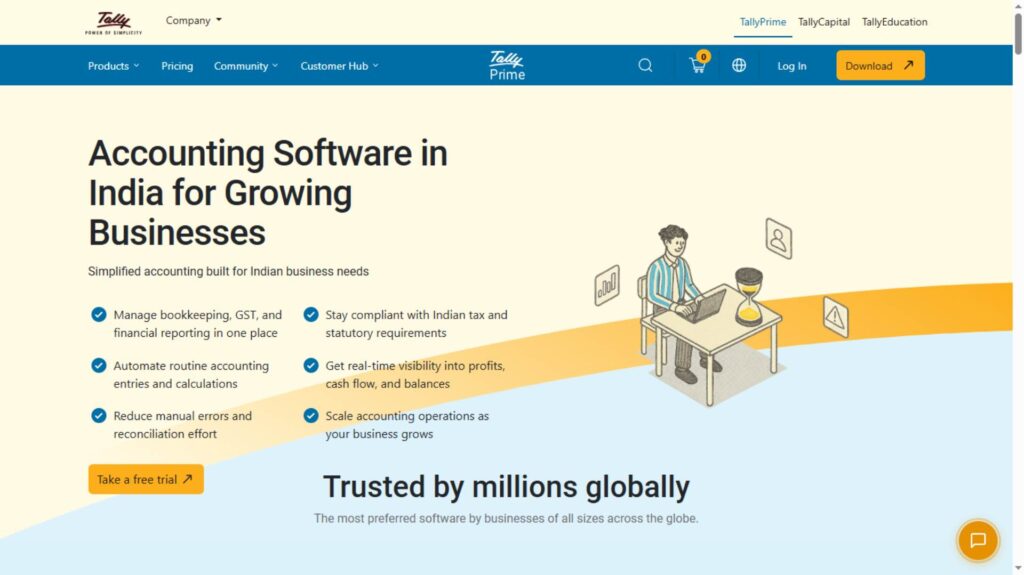
Type: Desktop-oriented accounting software with connected services.
TallyPrime remains a practical choice for Indian CA firms that work extensively with traditional ledger-based accounting. It supports financial statements, inventory records, GST compliance, banking, e-invoicing, and multi-company accounting. Its single-user and multi-user editions provide flexibility for different office setups.
For firms already managing many clients on Tally, adopting automation integrations may be more practical than replacing the entire accounting environment.
Key Features
-
Comprehensive ledger management and financial reporting.
-
GST accounting, reconciliation, and statutory workflows.
-
Inventory, stock valuation, and business reporting.
-
E-invoicing and e-way bill capabilities.
-
Multi-company accounting and multi-user options.
Pricing: TallyPrime Silver starts at ₹750 per month or ₹22,500 for a perpetual licence. TallyPrime Gold starts at ₹2,250 per month or ₹67,500 for a perpetual licence. Prices exclude GST. Ongoing services and updates may require maintaining the relevant subscription or support entitlement.
What We Like
-
Comprehensive accounting and inventory functionality.
-
Established workflows suited to professional bookkeeping.
-
Flexible rental and perpetual licensing options.
What to Keep in Mind
-
Fully remote collaboration can require additional arrangements.
-
New users may need training in Tally accounting workflows.
-
Advanced AI functionality may depend on third-party tools.
Editor’s Verdict: TallyPrime is a strong choice for CA firms prioritising detailed bookkeeping, GST functionality, and continuity with existing client systems. It is particularly suitable when accounting depth matters more than browser-first collaboration. Firms seeking automated document extraction can consider using TallyPrime alongside a specialist automation platform.
2. Zoho Books — Best for Cloud Accounting and Client Collaboration
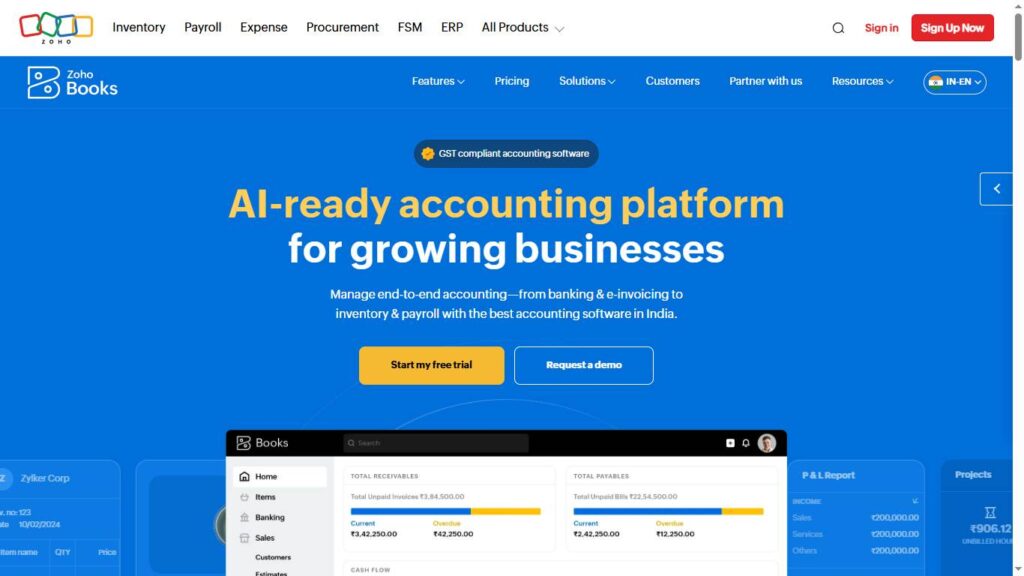
Best for: CA firms working with startups, service businesses, and clients needing accessible cloud records.
Type: Cloud-based accounting software with configurable automation.
Zoho Books provides cloud accounting capabilities, allowing authorised users to manage transactions, invoices, expenses, bank reconciliation, and financial reports across devices. Its GST features and workflow automation make it particularly relevant for firms assisting clients who prefer online accounting.
The software offers accountant access, customer portals, and user permissions, while higher plans support additional customisation and collaboration features.
Key Features
-
GST invoicing, reporting, and filing-related workflows.
-
Bank reconciliation and expense management.
-
Recurring invoices and automated payment reminders.
-
Accountant access and configurable permissions.
-
Receipt autoscans and workflow customisation.
Pricing: A free plan is available for eligible businesses. The Standard plan starts at ₹749 per organisation per month when billed annually, or ₹899 on monthly billing, excluding taxes. Higher plans provide additional functionality, users, and transaction limits.
What We Like
-
Convenient remote access and cloud collaboration.
-
Broad financial reporting and automation tools.
-
Flexible plans for businesses at different growth stages.
What to Keep in Mind
-
Subscription costs can increase with users, add-ons, and higher-tier plans.
-
Each client organisation’s licensing requirements need consideration.
-
Specialised CA practice management may require additional software.
Editor’s Verdict: Zoho Books is particularly suitable for CA firms supporting startups, service businesses, and distributed finance teams. Its combination of cloud accessibility, GST functions, and configurable workflows provides a useful alternative to traditional desktop accounting. Firms handling highly specialised inventory processes should verify that the relevant plan supports their requirements.
3. BUSY Accounting Software — Best for GST-Intensive Trading and Inventory Businesses
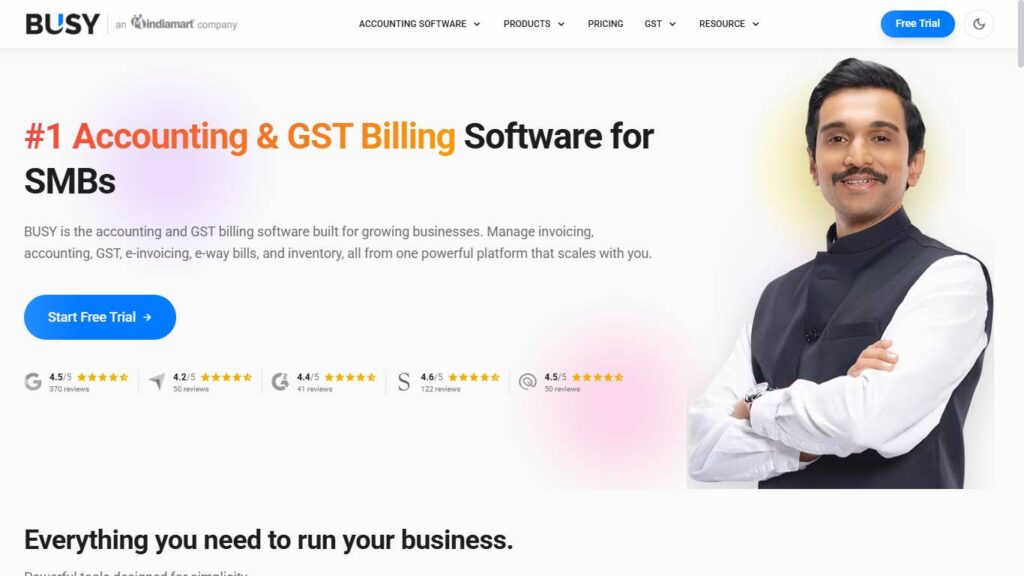
Best for: CA firms serving traders, distributors, wholesalers, and businesses with substantial stock records.
Type: Accounting and inventory software with desktop and connected-access options.
BUSY combines financial accounting, billing, inventory management, and GST functionality. Its product range is designed to accommodate different operating requirements, from smaller businesses to companies dealing with multiple GST registrations and more complex stock management.
For CA firms managing trading businesses, its accounting and inventory integration may help maintain consistent financial records.
Key Features
-
GST billing and compliance-related functions.
-
Inventory management across multiple locations.
-
Multi-company and multi-financial-year accounting.
-
Receivables, payables, and ledger reconciliation.
-
Financial statements, audit trails, and user access controls on applicable plans.
Pricing: BUSY offers a free Express edition. Its SMART subscription, which includes GST functionality, is listed at ₹8,000 for 360 days. A Standard perpetual licence is listed at ₹16,500, excluding GST. Support renewals and online access may cost extra.
What We Like
-
Detailed inventory and trading-related functionality.
-
Options for both subscription and perpetual licensing.
-
Multiple tiers for different business requirements.
What to Keep in Mind
-
Features vary substantially between editions.
-
Online access and renewals may add to total costs.
-
Some newer automation features are marked as upcoming.
Editor’s Verdict: BUSY deserves consideration for CA firms managing clients with significant inventory, billing, and GST workloads. Its strength lies in connecting operational stock information with accounting records. Firms focused primarily on cloud collaboration or AI-first bookkeeping may prefer another platform or an integrated automation tool.
4. Vyapar — Best for Small Businesses and Budget-Conscious CA Clients
Best for: Small retailers, independent businesses, and CA firms handling relatively straightforward client books.
Type: Billing, inventory, and small-business accounting software.
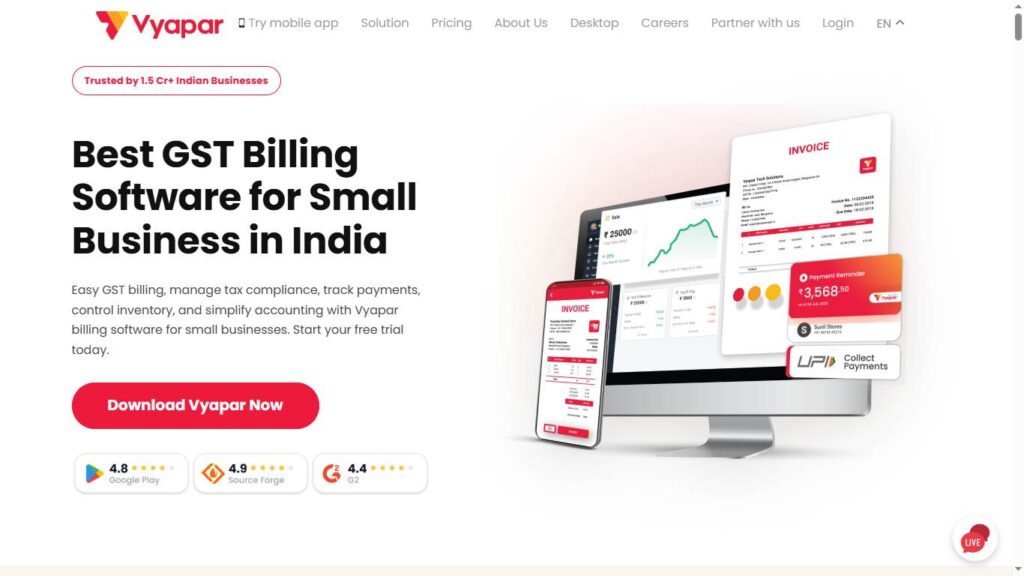
Vyapar focuses on making everyday accounting and billing manageable for small businesses. It supports GST invoices, expense records, inventory tracking, and financial reporting, with mobile and desktop options.
Its straightforward billing-oriented workflows can make it suitable for clients who maintain routine business records themselves and share the information with their accountants. However, available accounting modules and company limits depend on the selected plan
Key Features
-
GST-compliant invoice generation and reporting.
-
Expense and payment tracking.
-
Inventory and stock monitoring.
-
Profit and loss and related business reports.
-
Accountant access or data sharing on supported plans.
Pricing: Vyapar publishes free mobile options and paid desktop packages. Its currently listed Silver and Gold desktop plans start at ₹3,799 and ₹4,099 per year respectively on one official pricing page. Offers, device coverage, and feature entitlements vary.
What We Like
-
Accessible workflows for smaller businesses.
-
Useful billing and inventory features.
-
Lower entry costs than some larger accounting systems.
What to Keep in Mind
-
Advanced accounting functions are not available in every tier.
-
Business and device limits depend on the plan.
-
Not designed to replace a complete CA practice management system.
Editor’s Verdict: Vyapar is worth considering when CA firms support small businesses that need straightforward GST billing, expense tracking, and inventory records. It can provide a practical client-side bookkeeping option, although firms managing more complex accounting or audit requirements should assess its higher-tier features carefully.
5. Giddh — Best for Cloud Accounting and Growing Teams
Best for: Small and growing CA firms seeking cloud-based bookkeeping and access to client accounts.
Type: Cloud accounting platform with workflow automation.
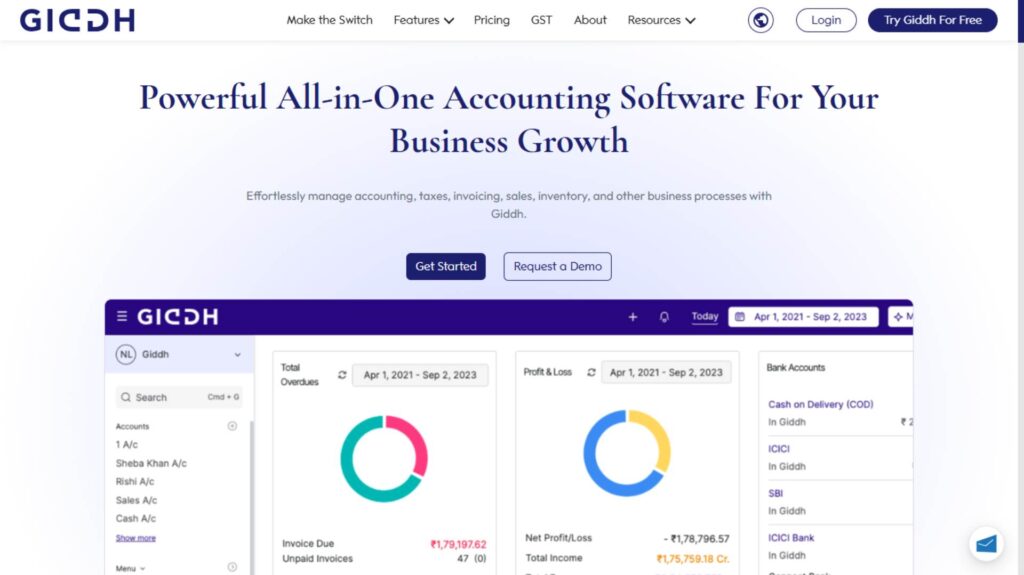
Giddh is a cloud accounting solution covering invoicing, ledgers, GST compliance, bank reconciliation, and financial reporting. Its published feature list includes multi-company accounting, accountant access, dashboards, and a range of inventory-related functions.
It offers another cloud-oriented option for firms seeking to move beyond manual spreadsheets and conventional desktop bookkeeping. However, its documented automation capabilities should not automatically be classified as generative AI or autonomous accounting.
Key Features
-
Cloud-based bookkeeping and journal entries.
-
GST compliance and filing-related functions.
-
Bank reconciliation and financial dashboards.
-
Multi-company accounting and accountant access.
-
Data import/export and inventory-related features.
Pricing: Giddh publishes an India-specific pricing and feature comparison page, but a reliable current starting amount was not established from the accessible pricing information. Confirm the latest subscription, usage limits, and add-ons with the vendor.
What We Like
-
Cloud accessibility for distributed accounting teams.
-
Combined GST, reporting, and bookkeeping functionality.
-
Features relevant to managing multiple businesses.
What to Keep in Mind
-
Validate current pricing and client-account limits.
-
Confirm which features require additional charges.
-
Assess AI functionality separately from conventional automation.
Editor’s Verdict: Giddh is a reasonable cloud accounting alternative for CA firms that want accessible records, accounting reports, and GST-related tools. It is worth comparing directly with Zoho Books, particularly on pricing, accountant permissions, and multi-client requirements. Firms seeking highly advanced AI processing should investigate specialist platforms.
6. Suvit — Best for AI-Assisted Data Entry and GST Reconciliation
Type: AI-assisted accounting automation platform.
Suvit focuses on helping accounting professionals automate repetitive processes involving invoices, bank statements, transaction records, and GST reconciliation. Rather than functioning primarily as a replacement for an established accounting ledger, it is particularly relevant as an additional processing layer.
Its published materials describe extraction from PDFs and spreadsheets, ledger mapping, Tally integration, and mismatch identification. This makes it a relevant option for firms wishing to modernise existing bookkeeping workflows without immediately migrating every client.
Key Features
-
AI-assisted document and transaction data extraction.
-
Bulk voucher processing and Tally integration.
-
Bank statement processing and ledger mapping.
-
GST reconciliation and discrepancy identification.
-
Document handling and workflow visibility.
Pricing: Suvit advertises trial access and CA-related benefits, but a reliable public starting subscription price was not confirmed. Request a quotation based on document volumes, users, and required integrations.
What We Like
-
Addresses repetitive accounting tasks faced by CA offices.
-
Can complement existing Tally workflows.
-
Focuses on Indian accounting and GST requirements.
What to Keep in Mind
-
It is not a direct substitute for every full-ledger accounting function.
-
AI-suggested classifications and extracted values require review.
-
Integration, processing limits, and total pricing need verification.
Editor’s Verdict: Suvit is particularly attractive for CA firms that already use TallyPrime but want to reduce manual data handling. It represents a practical approach to introducing AI-assisted automation without a complete accounting-system replacement. Firms should pilot it using real client documents and measure extraction quality before wider deployment.
7. Clear Finance Cloud — Best for Enterprise GST and Finance Automation

Best for: Larger CA advisory practices working with enterprise clients and complex tax workflows.
Type: Enterprise finance, GST, and intelligent automation platform.
Clear Finance Cloud is designed around interconnected financial processes, including accounts payable, invoice processing, GST compliance, reconciliation, and related finance operations. Its capabilities are more relevant to complex enterprise environments than to routine bookkeeping for small businesses.
The platform includes configurable reconciliation, electronic invoicing, and AI-supported risk insights. It is therefore best understood as a finance automation and compliance layer rather than a straightforward replacement for TallyPrime or Zoho Books.
Key Features
-
Automated invoice capture and processing.
-
GST reconciliation across complex business structures.
-
E-invoicing and e-way bill functionality.
-
Accounts payable and vendor process automation.
-
AI-supported compliance risk analysis.
Pricing: Pricing is quotation-based and depends on the modules, integrations, and implementation scope. No reliable public starting price was confirmed.
What We Like
-
Broad enterprise-focused automation capabilities.
-
Strong focus on GST and financial process integration.
-
Modular approach to compliance and finance workflows.
What to Keep in Mind
-
May be excessive for smaller accounting practices.
-
Implementation and integration requirements can be substantial.
-
Clear has announced a transition away from certain GST/TDS services for tax professionals and small businesses, so eligibility and the exact product offering must be confirmed before purchasing.
Editor’s Verdict: Clear Finance Cloud is most relevant to larger CA firms offering enterprise advisory, GST transformation, and financial process consulting. It should be considered for specific client engagements rather than as a universal accounting package for the entire practice.
Traditional Accounting Software vs AI-Powered Accounting Platforms
Traditional accounting systems and AI-enabled platforms address overlapping but different requirements.
| Feature | Traditional Accounting Software | AI-Powered / AI-Assisted Platforms |
|---|---|---|
| Data entry | Manual, imported, or rules-based | May extract and classify records automatically |
| Ledger accounting | Core functionality | May depend on an integrated accounting system |
| GST reconciliation | Built-in tools and reports | Automated matching and exception detection |
| Bank transactions | Import and reconciliation workflows | May suggest transaction categorisation |
| Client collaboration | Depends on access model | Often includes document and workflow tools |
| Human verification | Required | Still required |
| Primary benefit | Structured books and reliable records | Reduced repetitive processing |
For example, a CA firm maintaining client books in TallyPrime might introduce Suvit to process incoming documents and bank statements. The accounting records remain in Tally, while automation assists with the initial data processing.
Similarly, a practice using Zoho Books may already have enough built-in automation for recurring invoices, payment reminders, and bank-related workflows without immediately needing a separate AI product.
The key distinction is that automation improves how accounting tasks are performed; it does not automatically replace the underlying accounting system or professional judgement.
How to Choose the Right Accounting Software for Your CA Firm
1. Evaluate GST and Compliance Requirements
Consider the type of clients your firm serves and the GST processes they require. Some firms mainly need accurate invoices and routine reports, while others handle multiple GSTINs, high-volume reconciliation, and complex input tax credit reviews.
Check whether the software supports the exact workflows required and how regulatory updates are delivered.
2. Consider Client Collaboration and Access
A firm serving clients in several cities may benefit from cloud access, user permissions, and shared reporting. Desktop-based systems may remain suitable where bookkeeping is centralised within a single office.
Identify who needs access to client data and what each user should be permitted to change.
3. Assess AI and Automation Capabilities
Prioritise practical features such as document extraction, duplicate detection, ledger suggestions, bank reconciliation, and exception reporting.
A product advertised as AI-powered is not necessarily more useful than a conventional system with well-designed automation. Request demonstrations using actual accounting scenarios.
4. Check Integration and Scalability
Before switching products, evaluate existing data formats, integration options, historical records, and migration requirements.
Firms with numerous Tally-based clients may find an automation add-on more economical than replacing their entire accounting environment.
5. Compare Total Ownership Costs
Subscription prices do not always reflect the complete expense. Consider additional users, client organisations, cloud hosting, implementation, support, renewals, and data processing charges.
A relatively inexpensive accounting licence can become costly if significant manual processing remains necessary.
Which Accounting Solution Is Best for Different CA Firm Requirements?
| Firm Requirement | Recommended Solution | Main Reason |
|---|---|---|
| Established desktop accounting | TallyPrime | Detailed accounting, inventory, and GST functionality |
| Cloud-based accounting | Zoho Books | Online access and configurable workflows |
| Trading and inventory clients | BUSY | Inventory and business accounting capabilities |
| Small-business bookkeeping | Vyapar | Accessible invoicing and routine accounting |
| Alternative cloud accounting | Giddh | Cloud ledgers, reporting, and GST tools |
| Automating existing Tally workflows | Suvit | Document processing and accounting automation |
| Enterprise tax transformation | Clear Finance Cloud | Advanced reconciliation and finance automation |
These recommendations are based on product positioning and available documentation. A CA firm can also use more than one solution: for instance, TallyPrime for primary accounting and Suvit for additional data-processing automation.
The most useful evaluation is often whether the software reduces errors and processing time for the firm’s actual client workload, rather than whether it offers the longest list of features.
FAQs
Which accounting software is best for CA firms in India?
The best accounting software for CA firms in India depends on client requirements. TallyPrime suits detailed accounting and traditional workflows, Zoho Books supports cloud collaboration, and BUSY is useful for inventory-heavy businesses. Firms seeking AI-assisted processing can consider Suvit alongside an existing accounting system.
Is Zoho Books better than TallyPrime for CA firms?
Zoho Books may be more suitable for firms prioritising cloud access, remote collaboration, and configurable online workflows. TallyPrime is often preferable for established desktop accounting and inventory-intensive client records. Neither is universally better; the decision depends on accounting complexity, team structure, existing software, and budget.
Can AI accounting software automate GST and bookkeeping tasks?
AI-assisted accounting software can reduce manual work by extracting invoice details, suggesting ledger classifications, processing documents, and identifying GST reconciliation discrepancies. However, capabilities vary between platforms. Chartered accountants must still verify transaction accuracy, GST treatment, and final compliance submissions.
What is the best accounting software for small CA firms?
Smaller CA firms can consider TallyPrime for established bookkeeping workflows or Zoho Books for cloud-based accounting. Vyapar may suit clients with simpler invoicing and inventory requirements. The selection should account for client numbers, licensing costs, staff familiarity, and the firm’s specific compliance responsibilities.
Is AI-powered accounting software suitable for Indian GST compliance?
AI-powered tools can assist Indian GST processes through invoice extraction, data comparison, reconciliation, and mismatch detection. However, firms should verify that the software supports current GST requirements and applicable filing workflows. AI-generated results must be reviewed before statutory submissions or tax credit decisions.
Final Verdict
The best accounting software for CA firms in India is not necessarily the platform with the most advanced AI features. It is the solution that supports the firm’s accounting requirements, client portfolio, compliance responsibilities, and available resources.
TallyPrime remains a strong option for detailed accounting, Zoho Books offers convenient cloud collaboration, and BUSY suits businesses with demanding inventory and GST workflows. Meanwhile, Suvit demonstrates how AI-assisted automation can improve existing bookkeeping processes without requiring a complete software replacement.
For firms serving complex enterprise clients, Clear Finance Cloud provides specialised finance and tax automation capabilities.
Before making a decision, compare shortlisted platforms using representative client data, verify current pricing, and evaluate how well each solution fits your accounting processes. The right combination of dependable accounting software and carefully implemented automation can support a more efficient, scalable CA practice.